Saturday, December 22, 2018

Farewell Kanazawa


So I awoke my last morning in Kanazawa, cheerful and refreshed.  I walked down to the 7-11 to get a couple of things, and noticed something neat that I had also observed in Tokyo after one of my traveling companions pointed it out: Construction companies here have an obligation to tell the public what the decibel counts inside and outside their sites are.  In Kanazawa, they also provide information about air quality, which is pretty cool.

This is video instead of a still picture because the refresh rate on the display happened to sync closely to my shutter speed and frame rate and I didn't think to do a longer exposure, so I just grabbed a quick video instead.  To the human eye, the display looks solid. 

I made it back to Hotel Pacific and ordered my 😭last😭 ginger latte. I struck up a conversation with our barista about how much I was going to miss them, and she smiled and said the magic phrase I had been secretly hoping for:  "Oh.  You could make them at home!" and grabbed the recipe book from behind the counter...
I took a picture of the original recipe as she read it out to me and I transcribed it into English, and I'll be making ginger syrup soon, now that I'm home!

I was delighted, and sung her praises to my traveling companions as they joined me, as I drank the (beautiful!) latte art flower she made me that morning.


My companions and I realized (tragically) that we wouldn't be able to fit a third sushi breakfast into our morning plans, and so we caught a bus to Kanazawa train station.  When we arrived, I was absolutely charmed by their fountain display.


It's animated, and the individual points of aerated water are the pixels.  It welcomes you to Kanazawa in both Katakana and the Romanized alphabet in between sessions of telling you the time.


There are also these glorious wooden pillars integrated in the metal structure of the entrance to the station.  I'll be revisiting them in a later post about design elements I found striking during my time in Japan.


It gave a really remarkable sense of volume to the place.

We found a locker, dropped our bags, and went to grab lunch at a chain
restaurant that is known for making Kanazawa style curry-- Pork katsu curry smothered in a rich warm brown sauce, on a bed of rice, with a pile of shredded cabbage alongside.


It was excellent, and they served a sort of Yuzu-shandy-esque wine cooler thing with it that was tart and refreshing alongside the richness of the meal.

They also served these, which are just cubes of pure cheese, fried in the same dough they use for the katsu, and given to you in a gravy boat.  They're quite tasty, and are apparently the Kanazawa peer of mozzarella sticks you get in mid-tier Italian places in the states.


One thing I snapped a picture of as we were leaving was these baskets, which are an important indicator of a difference between American and Japanese thinking.


The Japanese are not inclined to put items on counters, or seats.  But since they're a "shoes off" culture, any place where you keep your shoes on (like many modern izakawas or say, a train station restaurant) you don't have anywhere to put your stuff, because the floor has had shoes on it, and is therefor not a clean surface either.  In a lot of Izakawas, this means there's a set of coat-and-bag hooks all down one wall where you're expected to hang your things out of the way.  In places where there isn't a wall next to your table, this becomes a puzzle though.

The solution is these baskets, generally one for every seat, either up against the counter in a setup like this, or under the seats if you're sitting at a normal table.


The basket, of course, doesn't count as "floor" despite being on the floor, and so is a place to put your stuff that is mentally "not floor" and therefore a good place to put things you carry, since shoes don't touch it.

It's a pretty handy thing, I found, since having a dedicated "place your stuff goes" actually made it easier to get in the habit of checking to make sure you hadn't forgotten anything when you left a restaurant.  In the states, where I often toss my hat or coat in the booth next to me, I'm more likely to forget it, I find.

Friday, December 21, 2018

Groundhog mornings and artisanal afternoons.

I woke up and got a Ginger Latte, exactly as I had expected.

 This one was clearly an attempt at a leaf, which I found charming, but also my barista had clearly not made many leaves, and so the art wound up a bit more . . .vulva and less leaf than I think she was hoping for, judging by her helpless giggling as she handed it to me with an embarrassed head shake.

Regardless, it was, again, delicious, and I was saddened that I would be leaving them behind when I depart Kanazawa tomorrow.

My companions came down and after briefly hemming and hawing about it, we realized that we were all of one mind: we wanted more sushi.

So we went back to Mori Mori, the same place we'd visited before, and had some more fish.


Ok, we had a lot more fish.

Here's the final plate stack in the background, with my dessert (a delicious sort of jelly cube dish that reminded me of a Japanese take on Turkish delight) in the foreground.
 
 Because my traveling companions are like me about numbers (which is to say we do hypothetical math and arithmetic comparisons compulsively for fun), we did some math, and realized that eating the same meal we were eating here back home in Atlanta would have cost us about $420.  $140 per person for fish that was almost (but not quite) as good.

Here, the total bill was 8,300 Yen.  Which works out to $75.  So. . . $25 per person for almost $150 worth of fish at Atlanta prices.

I regret nothing.  It was delicious and I would do it again in a heartbeat.

After breakfast we walked across the bridge from our neighborhood into the Higashi Chaya district, which is sort of an "Old Kanazawa" full of small art galleries, artisinal shops, and restored houses in the traditional style.  The buildings were beautiful, and when I get my pictures off the Pentax you'll see some of the gorgeous architecure.

For now here's a few little snapshots.

The river:

This is a wall of gold leaf.  It turns out that Kanazawa was known for goldsmithing and gold leave back in the day, and we found a small gold jewelry and leafwork shop that made beautiful things, and was built in a restoration of an old gold storehouse, and so included a gold storeroom and two of the walls facing the buildings inner courtyard were covered completely in gold leaf.

So I know what it's like to stand in a warm golden beam of sunlight now, which is cool.


The stuff they were selling was beautiful, too.


Although the gold leafed chocolate cake might have been a bit much.

One of my traveling companions found a noodle shop, and so we stopped for Udon.  They had their own special spin on Kitsune Udon, which included a bit of Yuzu zest to add a hint of tartness, and it was very tasty. 

On the way back to our hotel, I noticed a sign I hadn't seen before.
 So we changed course and found this aggressively artisinal little chocolatier making stuff so high end it was hard to understand how they stayed in business in a town Kanazawa's size.

I suppose it might be because suckers like me drop in for a cinnamon hot chocolate and pain au chocolat more often than I expect.

Everything they made was excellent.
 

After we made it back to the hotel, I did laundry and took a nap and then we headed out for dinner.

We had planned to return to Bambi, which, all things considered would have resulted in us getting absolutely besotted, I'm sure, considering how good their cocktails were.

Our livers were saved by the private party that they were hosting, so we scrambled a bit and found plentiful recommendations for a tiny, super traditional place called Manmarumaru.

Right down to the all-Japanese menu and sitting on woven mats on the floor at low tables.

My companions are carefully studying the menu because it was handwritten entirely in Japanese, mostly in a script that could be described as "beautiful but also somewhat irregular."  The lack of an English menu was a great joy to my companions, who have been coming to Japan annually for a decade, and have noticed more and more places, even super-cozy traditional ones, all have an English menu now.


But the result was we got a sort of Okonomoyaki Omelet?  Which was BANANAS.  I don't mean it contained bananas. That would be disgusting. I mean it was so good it was actively unsettling.  The Katsuobushi flakes on top curled and danced and the eggs were perfect.  I was delighted, since moments before it arrived I had mused openly about feeling I was in the mood for okonomiyaki, and so this hit the spot exactly.

Moments later, as we were ordering more things, we had the most delightful exchange.

This is our proprietor and head-chef, cracking up as she tries to answer a question about one of the menu items.  Because she realized that she couldn't read what was written on the menu either, and had no idea what the item we were asking about was.  It was adorable.


We wound up with a few other great things anyway though, including a really tasty bunch of fried squid.


Again, we finished our day off well fed and happy with our lot in life.

Tomorrow we would part ways, with my companions headed off to another Onsen and me headed back to the big city--a long Shinkansen ride directly to Tokyo.

Thursday, December 20, 2018

Feasting in Kanazawa.

Last time my traveling companions visited Kanazawa, they went to a place called Plat Home, where the proprietor chatted with them about the states and stuffed them full of amazing food.

So we set out to repeat that experience, only to find out (around 18:00) that they wouldn't have a table for us until around 20:30.

But the proprietor was delighted to see us and encouraged us to go a couple blocks down the street to a bar called "Bambi" and have drinks there, then come back.

So we did.

Since Bambi was situated at the edge of Omicho market, we had seen their signage earlier and were curious, so we trundled a couple blocks down the street and climbed the stairs to the bar just as they opened.

It turned out they had a really lovely bar, and an excellent bartender with a penchant for shaken drinks and a gift for great ice work.

The bar was pretty.  The entire bar was a single piece of tree, which was beautiful, and the silhouette of the cartoon character behind the bar added just the right touch of whimsy.


The Tom Collins I ordered came with a single rectangular column of ice in it, which was brilliant, and the cocktail was delicious, since the bartender used Yuzu liqueur and soda in place of the sour mix.

Even though we had dinner plans, they were house away, so of course we got some food at Bambi too.  Thess were their cool "egg and pork pinchos".  We also got sent some of their homemade chocolate fudge.  Just because.

Overall, A+, would pregame one food bar in another food bar again.

 So then we headed off to Plat Home, and oh wow, was it worth the wait.

I started with Tamayo, which was listed as "Blood orange beer" on the menu.  As far as we could tell, it was a Lambic, and damn, was it delicious.  Tart and sweet in just the right measure, and beautifully orange.


and the food!  Oh goodness.
Here's their "duck sliced with mustard" which turned out to be mustard greens.  It was absolutely perfectly cooked and the mustard greens were so, so good.
 

This was their Gyoza, which was served under a bed of wildflowers.


After the beer was gone we switched to Sake.

One of the sake cups they brought us was a piece of Kintsugi art!

A friend had introduced me to the concept of Kintsugi (Golden Joinery) a few years ago, and it became more widely known in the US after Death Cab For Cutie released an album by that name around the same time.

The philosophy behind Kintsugi (that broken things can be made beautiful in their repaired state by fixing them in a way that acknowledges their history as broken objects) has always struck me as nourishing and healthy, and it was delightful to see such a piece on display here. 

 The Sake that we drank from it was damn good, too.

 Another dish we loved: that's grilled Lotus root, covered in shredded cheddar cheese and black pepper.  It was a really surprising set of flavors and textures and we all thought it was excellent.  It was gone in moments and we almost ordered a second round of the stuff.

We finished off dinner with "Catalan Creme"--a dish I had never had before, which perfectly finished off the meal, cold and crisp and just the right amount of rich without being too rich, and sweet without being too sweet.

After dinner, a tradition that I had noticed in smaller restaurants where my traveling companions made an impression played out.  It's an old one that still happens sometimes in American restaurants, but isn't super common there--the proprietor came by to chat.

This particular case was especially refreshing, since my companions spoke some Japanese and he wanted to practice his English (which was quite good) as well, so I got to follow along through hearing his half of the conversation and picking up a few words along the way.  After last year's visit they had started following his social media posts about the food he's making/studying, and so we talked for a time about cuisine and the choices on his men.

He struck me as a very smart man with a clear penchant for running a world class restaurant, and I would tell anyone headed for Kanazawa that they should absolutely move heaven and earth to make sure they get a chance to see what he's doing there.

We careened home happy, tipsy and stuffed to the gills with good food.

In both company and cuisine, I don't know that I could have asked for a better evening.

Kanazawa - Gates, Castles, Duck Soba, and Gardens.

 After coffee, we headed down to the Kanazawa castle.  For many generations, Kanazawa, since it was fairly remote, was a relatively unchallenged feudal state, with a strong center of government that resided in a gigantic, sprawling castle on top of a hill.  Sadly, the castle was burned down (possibly intentionally, politics in the Meiji and post-Meiji era got. . . weird, as power was centralized in Japan).  However, the gate and part of the wall/observation system have been rebuilt, and we spent several hours walking through it.

The architecture is beautiful, and striking, and I'll pull all the pictures off my real camera when I'm home hopefully and share those pictures.  For now here's the handful of snapshots I took with my phone.  At the top you see one of the main gates that has been completely rebuilt.

 In keeping with the Japanese fondness for sharing all the information: here's a very detailed diagram of all the different types of wood that were used in a building like the gate, above.

 The entrance to the castle itself.

What happens when you travel with companion who are geeks about buildings?  You get to hang out while one of them takes a video of the rendering of the assembly process.  I don't blame her--the video was super cool. . .

 ...Because it was an animation of all the joints that were made like this.  Turns out a lot of Japanese construction in that era was a sort of insanely complex game of pickup-sticks in reverse.


 The results speak for themselves.  Beautiful buildings that are pretty resilient to earthquakes, while still being regal and massive.


After the castle, we stopped for lunch at a place nearby, and I got a bowl of duck meat and buckwheat soba noodles.  My companions told me that soba noodles are something that Kanazawa is known for, so I decided on it as my lunch.  It was tasty, but at this point my bar for noodle soups has been risen to the point where you've really got to be amazing before I can rave about them.


After lunch we wandered over to the Kenroku-en gardens, and they are absolutely beautiful.  A really striking blend of beautiful paths, careful planning, and excellent gardening and . . . plant-husbandry (is that a thing?) skills.

Sadly, almost every picture of the gardens that I took is on the real camera, so you'll have to wait on those for the "the beauty of Japan" pictures get posted next week sometime.

For now, here's a radio tower.
 

Yes, really, this is apparently the way the Japanese were building radio towers in the 1940s.

Isn't it cool?

Ginger Latte, Sushi breakfast, and Coffee.


So, when we were checking in, I had noticed that Ginger lattes were a thing on the menu. So I got up early(ish) the next morning and ordered one.


Since I wasn't sure when my traveling companions would be ready, I got it in a takeaway container.


Instagram stardom, here I come.

Here's the important part: that ginger latte?  DELICIOUS.  It is basically exactly what I want whenever I want a latte with some sweetness to it.  The taste was warm and gingery and also had a little bit of spicy kick that I found captivating.   I realized right away that I'd be getting one each morning we were here.

After the latte, my traveling companions came down and suggested the best possible idea for breakfast: Sushi.

Hotel Pacific, where we were staying is right next to Omicho market, a bustling fish market with a couple of sushi places that open for breakfast and buy directly from the vendors, so the fish is basically fresh and delicious and perfect.

Here's the important part, you can get two slices of fatty blue-fin tuna there for 700 yen.  About $3.25 per slice.  In the states each of those slices would run you about $15.  Each.

The sushi place has the cheap stuff that can last a few minutes before eating on a conveyor belt, but the tables are also served by a TRAIN SYSTEM.

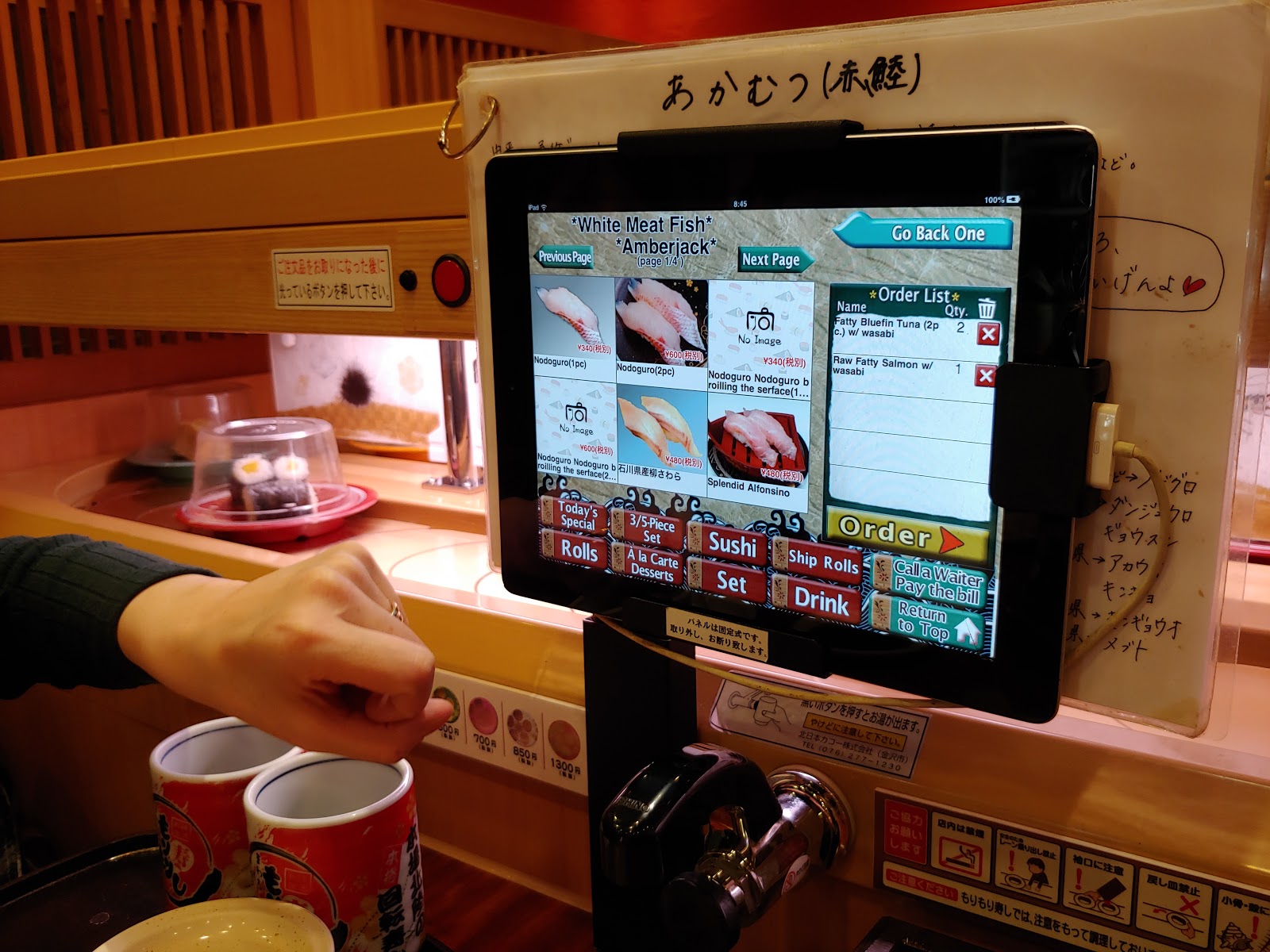
See, you order this magical fish from a screen. . . .


AND THEN A TINY TRAIN COMES TO YOUR TABLE WITH YOUR FISH.


Like. a real little train.  Loaded with the best fish.  How even.
I was delighted.

Long story short, we ate a ton of great fish.

I also ate one mediocre fish that I needed to check the box on.

This is フグ.  Aka "Fugu" in English.
 

This is the one that kills you if it's prepared wrong.

Clearly, I'm updating the blog, so, y'know, box checked, I guess.

Truthfully it's a pretty flavorless white fish with a slightly rubbery texture.  Worth making sure I'd had it, so that I could tell you that information, but in the future given the opportunity I think I'll always pick more fatty bluefin tuna instead. 

After breakfast we went for coffee, because coffee.  There is a beautiful traditional coffee house that roasts its own beans near our hotel, so we wandered over there and sat at the bar and talked.


The coffee (I had one from Yemen) was delicious.